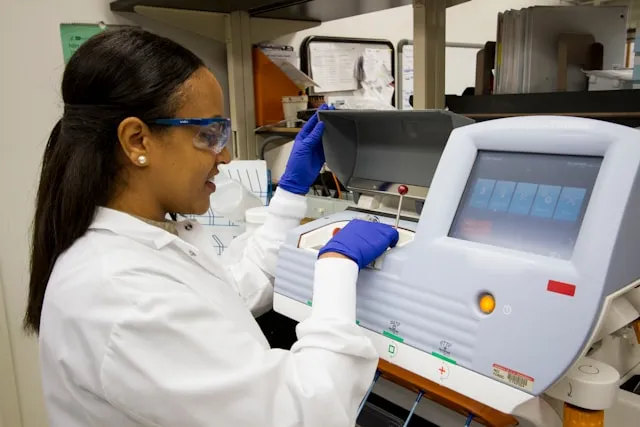
Early ADME & DMPK screening
Solubility, permeability, plasma protein binding, blood-to-plasma ratio, metabolic stability, and other candidate-screening assays.

Integrated ADME, DMPK, and pharmacokinetic studies to characterize absorption, distribution, metabolism, excretion, exposure, and drug-interaction potential before candidate advancement.
DMPK strategy can begin with rapid in vitro ADME screening and extend into in vivo pharmacokinetics, bioavailability, tissue distribution, mass balance, metabolite profiling, and enzyme or transporter studies. Scope is matched to the molecule, modality, and development question.
Solubility, permeability, plasma protein binding, blood-to-plasma ratio, metabolic stability, and other candidate-screening assays.
Single- or repeat-dose PK studies using project-appropriate species, routes, matrices, sampling schedules, and bioanalytical methods.
Systemic exposure, absolute or relative bioavailability, tissue distribution, and target-tissue exposure where required.
Recovery and excretion-route assessment with study format and analytical approach confirmed for the specific program.
Metabolite identification, cross-species comparison, metabolic pathway assessment, and selected metabolite exposure.
CYP inhibition or induction, reaction phenotyping, transporter substrate or inhibition studies, and drug-interaction risk assessment.
Concentration-time profiles and parameters such as Cmax, Tmax, AUC, half-life, clearance, and volume of distribution.
Bioavailability, permeability, protein binding, blood partitioning, and tissue exposure.
Metabolic stability, metabolite identity and abundance, enzyme contribution, and cross-species comparison.
Mass balance, excretion routes, transporter activity, and enzyme- or transporter-mediated interaction potential.
Assay availability, species, analytical method, sampling design, timelines, and deliverables are confirmed during technical review.
Share the compound, development stage, known properties, intended route, and decision question. We can coordinate the appropriate screening and in vivo study sequence.Required fields are marked with an asterisk(*).