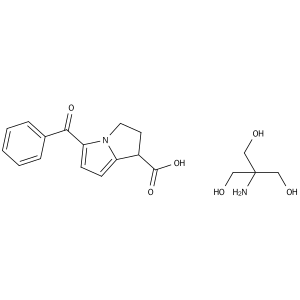
Ketorolac
In Stock•Starting at $21 for 100 mg•Purity ≥ 98%
| CAS No. | 74103-06-3 |
|---|---|
| MDL No. | MFCD00864281 |
| MF | C15H13NO3 |
| MW | 255.27 |
| InChI Key | OZWKMVRBQXNZKK-UHFFFAOYSA-N |

| CAS No. | 74103-06-3 |
|---|---|
| MDL No. | MFCD00864281 |
| MF | C15H13NO3 |
| MW | 255.27 |
| InChI Key | OZWKMVRBQXNZKK-UHFFFAOYSA-N |
| Pack Size | Purity | Price | Availability | Action |
|---|---|---|---|---|
| 100 mg | 98% | $21 | In Stock | |
| 250 mg | 98% | $27 | In Stock | |
| 1 g | 98% | $44 | In Stock | |
| 5 g | 98% | $105 | In Stock | |
| 10 g | 98% | $172 | In Stock |
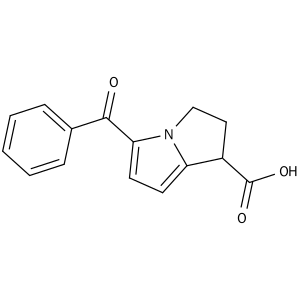
Ketorolac is a racemate consisting of equimolar amounts of (R)-(+)- and (S)-(-)-5-benzoyl-2,3-dihydro-1H-pyrrolizine-1-carboxylic acid. Only the (S)-(-) enantiomer inhibits COX1 and COX2, while the (R)-(+) enantiomer exhibits potent analgesic activity. As a non-steroidal anti-inflammatory drug, ketorolac is primarily used (generally as the tromethamine salt) for short-term post-operative pain management and in eye drops to relieve ocular itching in seasonal allergic conjunctivitis. It was withdrawn from many markets in 1993 due to associations with haemorrhage and renal failure. It functions as a COX1 and COX2 inhibitor, a non-steroidal anti-inflammatory drug, and an analgesic. It contains both (R)- and (S)-ketorolac and is a conjugate acid of ketorolac(1-).
| CAS No. | 74103-06-3 |
|---|---|
| Product Name | Ketorolac |
| 25 g | 98% | $283 | In Stock |
| 4*25 g | 98% | $1109 | In Stock |
| Custom synthesis and bulk supply options are available upon request. |