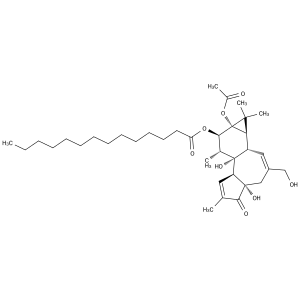
Phorbol 12-myristate 13-acetate
In Stock•Starting at $149 for 5 mg•Purity ≥ 95%
| CAS No. | 16561-29-8 |
|---|---|
| MDL No. | MFCD00036736 |
| MF | C36H56O8 |
| MW | 616.80 |
| InChI Key | PHEDXBVPIONUQT-RGYGYFBISA-N |

| CAS No. | 16561-29-8 |
|---|---|
| MDL No. | MFCD00036736 |
| MF | C36H56O8 |
| MW | 616.80 |
| InChI Key | PHEDXBVPIONUQT-RGYGYFBISA-N |
| Pack Size | Purity | Price | Availability | Action |
|---|---|---|---|---|
| 5 mg | 95% | $149 | In Stock | |
| 10 mg | 95% | $233 | In Stock | |
| 25 mg | 95% | $348 | In Stock | |
| 50 mg | 95% | $475 | In Stock | |
| 100 mg | 95% | $783 | In Stock |
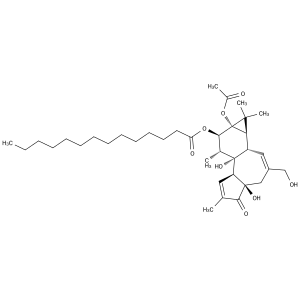
Phorbol 13-acetate 12-myristate is a phorbol ester in which the hydroxy groups at the cyclopropane ring junction (position 13) and the adjacent carbon (position 12) are converted into acetate and myristate esters, respectively. It is a major active constituent of the seed oil of *Croton tiglium*. It functions as a protein kinase C agonist, a reactive oxygen species generator, a mitogen, a carcinogenic agent, and an apoptosis inducer. It has been used as a tumor-promoting agent in rodent skin carcinogenesis and is associated with increased cell proliferation in malignant cells, though its function remains controversial due to observed decreases in cell proliferation in some cancer cell types. It is also classified as an acetate ester, a tetradecanoate ester, a diester, a tertiary alpha-hydroxy ketone, and a plant metabolite.
| CAS No. | 16561-29-8 |
|---|---|
| Product Name | Phorbol 12-myristate 13-acetate |
| 500 mg | 95%+ | $1233 | In Stock |
| 1 g | 95%+ | $1970 | In Stock |
| Custom synthesis and bulk supply options are available upon request. |